Showing posts with label Valluvanad. Show all posts

Tuesday, March 3, 2015

Black and White Wednesday # 158 : Puli Inji / Kerala Tamarind Chutney


Tamarind Pods for Puli Inji/ Tamarind Chutney for BWW #158


Thank you! to Cinzia who blogs at Cindystar and Susan, The Well Seasoned Cook. Tiffin Carrier Antic/que's! is honoured to host the Black and White Wednesday # 158.
 
This goes to the Black and White Wednesday #158 hosted here.
Puli Inji/ Tamarind Chutney
 
Traditional Valluvanad Puli Inji/ Traditional Valluvanad Tamarind Chutney
 

Sunday, April 14, 2013

Vishu...

For the memory of Cassia Fistula flowers...
In lieu of Kani Konna, early morning sunlight on the the daffodils from our garden; a light dusting of  the soil. Unedited photograph.
Unda Sammanthi: Roasted Red Chilli and Coconut Chutney with Pappadams

This year, we have no traditional celebrations due to a death in the family. In lieu, I have memories to share  with perhaps only a replica of recipes,  to conjure up a scene from another time and space.

No taste! No Flavour!
Not like 'back home'! ...are the phrases we don like a second skin. We become zealous guardians of our 'traditions', fervently  striving to recreate the flavours and aroma's of what we left behind. What is real and what is presented for our audience through the blog is often left unanswered with our props, substitutes, posting and 'presentations'. The exercise often takes a stark, physical view of what  represents our food, tradition and culture. As long as they look like the originals, as along as they feel and perhaps taste (?) like what we used to get back home? As long as we do it on the same day of our solar / lunar calendar we have not let anyone or anything down. Then we may not ponder much on the disconnect across the oceans  and the actual seasonal connection of our cuisine to our land. 
Matta Ari Kanji, Chakka Puzhukku, Pappadam and Unda Samanthi
We may never use newly harvested rice, which symbolizes the new year for  traditions which revolve around growing seasons. Our Vishu Kanji had to do with store-bought parboiled Matta Rice, Chakka Puzhukku made with frozen jackfruit and was served on regular Corningware plates! But we did grind our coconut chutney on a grinding stone! Not the dark granite one's used in Kerala but one that gave similar results. This  pink, sandstone, Sil-Batta has northern provenance but in Ma's expert hands, produced a favourite recipe. She made  the occasion special.
This goes to Black and White Wednesdays # 79 , created by the The Well Seasoned Cook
and hosted this week by Food and Clicks
Vishu was always celebrated with our grandparents. Rice was important. After the morning ritual of Vishukani, Vishu kanji would be prepared. In some parts of Kerala there are elaborate feasts. In our nook, this humble, everyday dish is celebrated.

Puthari Kanji Vishu Kanji was special. One could use 'old' rice or the newly harvested rice for Vishu. If Puthari ( Puthiya Ari = New Rice) was used, it  was considered auspicious to  use a length of Uzhinja creeper around the cooking pot. Uzhinja- Cardiospermum Halicacabum, a native perennial creeper  is also  one of the ten sacred, medicinal plants in Kerala's folk and Ayurveda tradition, known as the  Dasapushpa's/ ten flowers. 


Chundakka Another important accompaniment to the Puthari Kanji was a dish made with the bitter Turkey Berries/ Chundakka.  Lightly sauteed in coconut oil, seasoned only with salt and red chilli powder.

Chakka Puzhukku The Vishu kanji was served with a touch of dried ginger/ Chukku, rock salt, clarified butter/nei and perhaps a generous heap of grated coconut. Some garnished it with boiled green mung beans. It was accompanied by the traditional coconut chutney and a hearty seasonal stew, the Puzhukku made with tender  unripe jackfruit pods and adzuki beans. The spicing was simple: turmeric, ground coconut and red chillies simmered with seasonal, raw jackfruit pods and soaked adzuki beans.

Tuesday, April 9, 2013

Black and White Wednesdays: Why you shouldn't be 'surprised' at fermented foods


Not just a " an eloquent protest against the homogenization of flavours and food now rolling like a great undifferentiated lawn across the globe..."

We often come across articles educating us lesser mortals on which food is good for us and why it is good for us. Most of them in the tone of a new discovery, of something we might have been too ignorant to know for our uninitiated, bad-eating-habit selves. After  one starts reading, one realizes that it is yet another 'American' / western discovery. One that many, 'looked-down-upon'  parts of the world take for fresh, normal, healthy, seasonal,  usually sustainable, locally sourced  food and eating habits. Since 'ancient times'.
Idli with a touch of seasoned Tomato and Onion Chutney
Of course, the implication here is that nobody should wrinkle up their noses on foods like Bread, Cheese, Beer, Wine, Chocolate, Coffee and Yogurt. These being gourmet foods that powerful nations and cultures have exalted to an elite status. Plus this food is so good that there is not even a tiny whiff of 'fermentation', and it is far  removed from the important word which is implied here. The very dirty one, 'rotten'. You  will and should however be pardoned for wrinkling your nose and sniffing at foods,  that are fermented and that do not belong to above seven categories and the cuisines they represent in the popular consciousness.

Mostly, food with an entirely different flavour profile, one which has  nourished very different cultures. What comes to your mind? 


Fresh batter poured into idli moulds and a batch of steamed idli's.
This goes to the Black and White Wednesdays # 78 originally created by The Well Seasoned Cook  and hosted this week by My Diverse Kitchen.

For me, it is the humble Idli, made from a ground paste of soaked rice  and black gram. In the hot, tropical, humid climate of the monsoons, our palate quickly adapted to fresh  food, fermented ground pastes steamed into nutritious vegetarian entrees, buttermilk and yogurt  whisked into easily digestible curries, chutneys and cooling summer drinks. It is  unsurprising then that,

We do not have to 'try to bring back' fermentation
We do not have to 'try to revive' an ancient tradition.

It is part of our living culture and tradition.
And it is alive.
And we are not afraid.
And no pun intended.

Plus,  we perhaps do not need a 'Guru' to teach us that!
Again, no pun intended.

In many ways, this reminds me of the  underlying humour regarding Kerala cuisine which touches on the traditional, Malayalee comfort food of sour, coconut-buttermilk chutneys like the Kaalan, Moru Curries and pulisseri's. The Kaalan would never go bad, it would only turn more sour. To balance out the sourness, one just added fresh coconut paste and vice-versa. This back and forth process would end  only when with the curry got over!

So  while experts foment and flog whatever is current and trendy, there are many food traditions and recipes that have  survived the onslaught of over processed, homogenized, frozen, left-over, cliched, fizz and foam! They could perhaps look at something like the Idli... to rise up and leaven, gently ripen to a perfect, tart, sourness and then  be steamed into something truly piquant. Effortlessly. It need not be contrived and unsavoury. The magic is alive. Just check.

Monday, February 18, 2013

Black and White Wednesdays: Rice / Unakalari


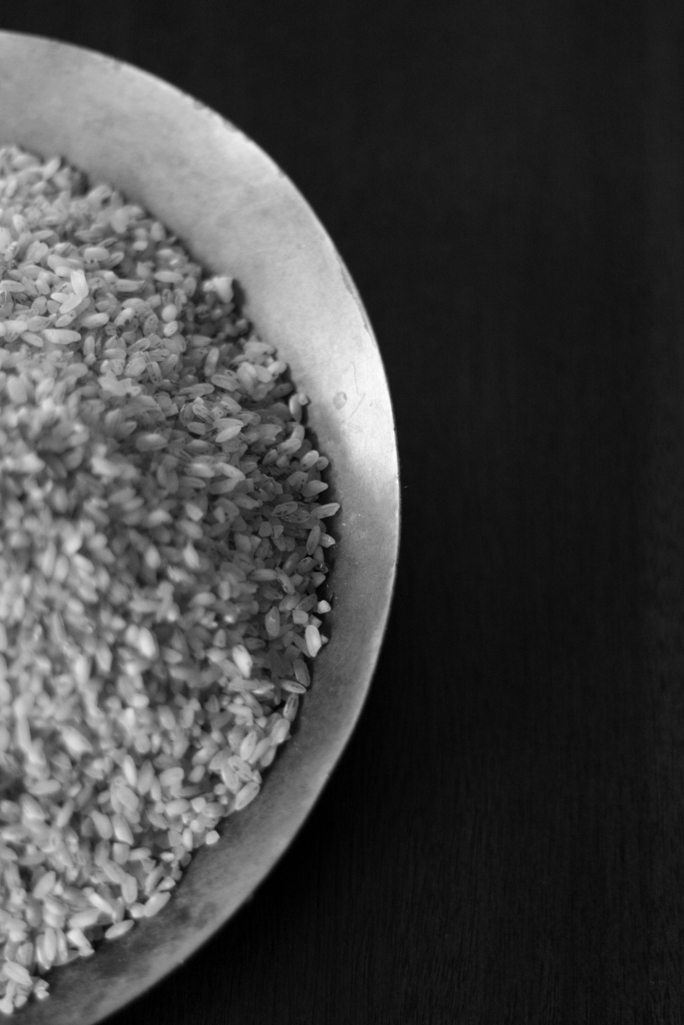
Unakalari/ Raw Rice with barn for Payasam
For Black and White Wednesdays managed by Cindystar and created by the lovely, Well Seasoned Cook Susan ; BWW # 71 hosted this week by Shruthi of Food and Clicks .
Raw rice in an antique Korikka/ Rice Server
The Moon Calendar we follow for our celebrations brings us the old and the new. A grandparent's demise  and a child's birthday  offers us different rituals. A parent's demise and an uncle's birthday come together. 

After the initial year, our mother wanted a simple ritual. So, for many years we made the annual, early morning trip with our grandfather. Sometimes with a grand uncle. We parked our car near the sloping concrete ramp which brought trucks hauling away the fine sand of the Bharathapuzha, our Nila...disappearing into our concrete mansions.
Ravaging our memories and consciousness...
Voices from the early morning truck drivers and bus staff wafted across the water. It  was still dark. Shivering in the morning cold my mother  and sibling would take a dip in the river. She and my sibling would follow the instructions. Small balls of rice grains and black sesame seeds left on the sandy river  bank with sharp stalks of Darbha. Trickling light before dawn.

We would  then drive up to visit the old temple on the rocky terrain. Part of the circumambulation rising up in rough, un-hewn, granite. Early morning stillness broken only by sweep of broomsticks across the temple  courtyards. This beautiful half-rock-cut structure from Kerala's Jain and Buddhist past. The deities tall, beautiful, and unadorned. The shocking red-orange of Hanuman was always a strange relief, before we went down the sharp slope of granite steps to the shrine for Ayyappa. Further ahead,  the path also led to the temple of a powerful goddess, whose annual festival resounds with fireworks echoing around the hills which nestle it. On the way out, we would stack up smooth stones under the banyan tree.
For good luck, protection to the family...
we never knew clearly 
but it was fun to see how many uneven stones could rise up...
much like Life itself.
Unakalari / Raw Rice for Payasam

Saturday, February 9, 2013

Vazhapoo / Banana Flower Vada


Banana Flowers in Red Bracts

Banana flower-head, appearing in the Indian Groceries during this season. Prompted by a recent visit to India and  the opportunity to sample Bengali cuisine  which included,   Banana Flower cutlets, we picked up a 'banana flower head/ Vazha Khumbu'. The opportunity to sample a traditional Bengali spread was at Kolkata's Bhojohari Manna.

Friday, August 31, 2012

Kadala Kootu Curry/ Black Chickpeas Kootu Curry


 Kadala Kootu curry with Rice.


Kootu Curry was a favourite Sadya item. This dark, rich, roasted coconut dish had to be 'dry', i e, the chickpeas cooked but not mushy. This is the traditional, old school recipe. Erisseri and Kootu Curry are very similar. There are some essential difference's:

  • Cumin is not used in Kootu Curry.
  • Split Pigeon Peas/ tuvara parippu/ tuvar dal is also not used
  • Grated Coconut is roasted liberally in coconut oil.
  • Urad Dal/ Split Black Gram is also used in the tempering mix.
  • Dried Red Chillies are not used in tempering

Wednesday, August 29, 2012

Onam Mathoru...


Hope you had a wonderful Onam celebration with loved ones...

     Indian   Jaggery Cubes...                          

For  one of the most elegant Mathevar/ Mahadevar/Mathoru created by RamaT at my grandparents home. These un-fired, fresh, clay figures were always proportionate, sharp-edged and symmetrical. My grandfather and later, my Uncle took  care in marking the ritual design on them: sharp rice flour lines running down the sides of the obelisk. After the last day of celebrations, it would be left among the flowerbeds to melt into the earth with the elements. Like Mahabali...

Maybe a cousin will email pictures and the post could be updated. Meanwhile, this goes to Susan's Black and White Wednesdays, hosted this week by Anusha of Tomato Blues. 

Sunday, August 19, 2012

Monsoon Memories: Sadya Manga Kari/ Kerala Mango Pickle for Feasts


Preparations for the Sadya, Manga Kari the previous day by traditional cooks. Photo taken with my point and shoot Nikon.

Sadya Manga Kari
This is the Mango Pickle, made for  a traditional Kerala feast, the Sadya. It is from our nook of Kerala. Think the regions straddling the districts of Palakkad, Malappuram and Thrissur. :-) These were the first dishes to made in the cooking sequence for the feast. Coconut Oil was liberally used. It keeps in the fridge for a week. This recipe has been in the drafts for a long time, since our trip to Kerala, last summer for a wedding during the monsoon.

Midhunathil Oru Kalyanam/ A wedding during the month of Midhunam
Blue Tarp covering the perimeter of the old house, bathing us all in unreal blue!
It was my cousin's wedding. It was the last in a generation.So our Uncle decided to wait for us- the Amerikyakkar- disregarding everything, particularly the South-West Monsoon! Sacrilege in many senses since it was going to be held at home, in our village and not in a 'hall'. And that is how we attended the wedding...family, relatives, drama, barbs, darts, fun, laughter, cousins and all!

It was scheduled in the month of Midhunam, which precedes the month of  Karkidakam. Karkidakom is considered inauspicious according to the Hindu Calendar for festivities. So, the fact that it did not rain two days prior to the wedding and  most importantly on the wedding day was huge. This fortuitous aspect was also a validation of several important, unspoken issues in a large, extended, sometimes feuding  clan. The 'holding off' of the Monsoon was akin to a small miracle, a result of the accumulated good deeds of family, forefathers, generations, answer to several prayers etc.etc....and most satisfyingly, a sharp snub to several relatives by Mother Nature herself!  :-D!
Raw mangoes being chopped on our old wooden bench, lined with banana leaves, in  the Aala/Multi-purpose shed in Palakkad district, Kerala.

Nothing like a fiery red Manga Kari, one of  the staple's of the  traditional Kerala feast, to put someone's  tongue to rest! A liberal quantity of coconut oil, covering the mango pieces would ensure the freshness and 'rich look' for the feast next day. Here is  a previously posted recipe for a smaller amount: Manga Kari/ Kerala Raw Mango Pickle.


Saturday, June 30, 2012

CWS- Black Gram: The humble Idli

 A small sliver of white. 
Not a favourite during our childhood-preference always won over by its companion item, the Dosa.
Served with Sambhar


Important
The quantity and ratio of the rice and black gram varies with the type of rice and method of grinding. The electric mixie [ mine is the old warhorse of Indian Kitchen's, the Sumeet ]
and the electric-stone grinder both yield a different quality of batter and this affects the end product.

Idli Rice/ Idly Rice: Whole Skinned Black Gram
  • For processing in the Mixie: 4: 2
  • For processing in the Grinder: 4: 1
The reason is that the Mixie 'cuts' the lentils/ black gram and hence will not allow the batter to 'rise' as  would grinding it between stones. So an extra measure of black gram in the Mixie-method will allow you softness in the idli.
This goes to Susan's Black and White Wednesdays # 39

Ingredients

4 Cups of Idly rice soaked for a minimum of 4-5 hours


2 Cups of Whole skinned urad dal: soaked overnight or for at least 4 hours.
Salt
Water
Method
Wash the rice  and black gram/urad dal separately, 
Soak  separately in plenty of water

In the Mixie
Grind black gram first. 
Add water carefully, little by little to grind it into a smooth batter

Grind rice.
Mix both batters together and pour it in a  deep container with enough space for fermentation and 'rising'.

Cover and keep in 'warm' place overnight or at least for 6 hours.

Batter should be slightly sour and should have 'risen'.
Check for salt.
Grease Idli-moulds with oil/coconut oil or gheeand pour batter into moulds.
Steam for 10 mts

Take off the heat, 
Sprinkle a little cool water over the idlis
Let sit for a couple of minutes
Gently un-mould with a spoon.
Serve with Chutney or Sambhar.
We had ours with Uzhunnu Vada
The recipe is submitted to CWS-June 2012: Black Gram event,  created by Priya and hosted here at Tiffin Carrier Anticque's. CWS-July: Red Kidney Beans is hosted here.
I will be posting the round-up in a couple of days. And, I have barely seconds before the clock turns to 12 and to July 1st.
:-)

Friday, June 29, 2012

CWS-JUNE 2012: Black Gram: Uzhunnu Vada/


The CWS-June 2012 Black Gram  is being hosted here. Created by the immensely talented, Priya of Priya's Versatile Recipes Just a last-minute reminder to send in all your fabulous Urad Dal recipes by tomorrow, June 30th, 2012.

This vada reminds us of the neivedyam offered to Hanuman at the ancient rock-cut temple.
This area in South Malabar/ Valluvanad is dotted with rocky hillocks cradling a famous Baghavathi temple, an ancient rock-cut passageway and cave.The Baghavathi temple is famous for its annual fire-works. This  temple  harks back to the Jain and Buddhist past of the region. The deities are tall and standing. Parts of inner circumambulation is uneven, unpaved and the natural rocky terrain on which the temple is situated.

It has a large paved  perimeter and the Hanuman statue was located in one part: roughly formed,  adorned  with  his rows of Vada-Mala/ Vada Garlands,  he was a powerful figure. The Vada's were  delicious. It had no other spicing except perhaps black pepper. We speculated that they sometimes had the flavour of Dalda or ghee.
They were always in the drop-batter shape and were brought back in big steel undavus/ vessels or steel buckets.


Friday, June 8, 2012

The Mango Showers of May: George Washington's Uppumanga!


Tiny tender green mangoes available in the Indian grocery stores from February. These are still available but would be slightly larger in size and would have developed a harder coat  around its 'stone' /the mango seed.


It was easier for George Washington to access Indian mangoes than hordes of 'yours truly's' from the sub-continent. However, GW got his mangoes pickled not blasted with radiation as it enters the US. 


Entering George Washington's Kitchen


We can trace the entry of people from India/sub-continent from the British Colonial  time,  to the maritime  workers who came through the western coast.  However...  Before the entry of early Punjabi  immigrants and ''chicken curries' from the sub-continent into the west coast...
Before the entry of smart, scientific and small groups of Indians working in  the exalted 'Sighyyence' field...
Before the wave of ambitious nerses, doctors and such... 
Before the wave of plentiful 'keyboard tappers and managers'...
Before the very ambitious Indian American's  courting favour with the highest echelons of American  power...
Way before the   carefully timed visit of  US Trade Representative, Susan Schwab in March 2007,  riding  the machismo of the Harley Davidson to wrangle Alphonso mangoes in return from the Indian Commerce Minister, Kamal Nath... 


Long before all this,the humble and zimble UppuManga  had achieved the favoured status to travel  with an English name, 'pickled mangoes', as an elite cargo to grace George Washington's table. :-)

                                 
Now, the claim that the Uppumanga traveled to grace the White House occupant's table is speculation.

  •  We do not know what kind of pickled mango boarded the ship from India 
  • We do not know what avatar graced one of the important dining spots in the newly independent America.

Historical trade routes and sources of mangoes would point towards the western coastal region of India. The mangoes might have come from anywhere from the coast of Gujarat, Rajasthan, Maharashtra, Karnataka or Kerala.

Sunday, September 11, 2011

Onam Sadya Vibhavangal: Kerala Onam Feast

Last week was Onam. It was small, quiet, reflective with a hangover from our recent visit to India. Visions of home and 'plenty' by way of benana leaves [:-)!], traditional flowers, the mud Mahadevar/ Maathoru, the traditional rice paste motifs on the nadumittam /central courtyard of grandparents home and the food made at home always permeate this occasion here.

Memories of our childhood were of large Uthradom feasts. Kerala's feudal past is integral in these memories and it comes from the privileged end of the spectrum. The Uthradom feast was made by traditional cooks in the outdoor cooking fires. According to South Malabar's/ Valluvanad's feudal, landowning tradition and accounts, new cloth, money, and  a certain amount of paddy was measured out to the tenants and families who had toiled for generations under that particular landlord's family.  


Certain dishes were made only on occasion and never as and when one wants! The ten days of this harvest festival, where paddy was the backbone of the feudal economy, were busy with the preparations of different sweet meats, and savoury snacks  culminating in the grand feast.
As our last year's Onam Sadya, our benana leaf  was the melamine plate. For Uthradom, we had a simple Paal Payasam, as served at my maternal grandparents. For ThiruOnam, jaggery stewed plantains replaced the payasam, as was the tradition in my paternal grandparents home. Did not make Mulaga Pacchadi this time nor the Sharkkara Upperi or Varutha Upperi.

In our particular part of South Malabar, Uthradom Sadya   had all the traditional items. ThiruOnam was quieter, early in the day, with only a few fresh dishes made by the women of the family. It was also the day for one of the annual visits to one's maiden home.
ThiruOnam feast served on our melamine, benana-leaf: Kaalan, Olan [made with winter melon and raw pumpkin here], Avial/Aviyal, Erisseri, cooked Tuvar Dal/split Pigeon Peas, fresh Ghee/clarified butter, fried jackfruit chips from India, Olvakkode banana chips [ the famous chips from the Palakkad area], jaggery-stewed ripe plantains, Pappadums,  Lemon Acchar [ in lieu of Vadukkapuli Naranga Acchar/ Wild Lemon Acchar, Varuthuaracha Sambhar, Palakkadan Matta Rice on one day and white rice on the other.
Aviyal/Avial and Olan
Olan
Kaalan

Our Uthradom Feast
Instead of Sambhar, we had Moru Curry/ Moru Kootan/ Buttermilk Curry. Dishes on the melamine plate was served to lamp. This is how we had ours! :-)
Tender Winter Melon growing over the cowshed at our Uncle's ancestral home
Bags of un-husked coconuts  piled up at the Pathaya-pura/Granary one of the few that has survived.The de-husking implement in the foreground.
Tender winter melon, yellow cucumber,  tender pumpkins, raw plantains are in the season during this time  and were traditional 'kayzhchha veppu'/ offerings given to the landlord.