Friday, August 27, 2010

Parippu Vada: Dal Vada/ Deep Fried Lentil Discs


Parippu Vada and Chai/Chaaya  is one of the quintessential Mallu tea-shop favourites. Chaayakada= tea shop tea is a strong 'pulled-tea' with frothy topping! With this heritage, the Parippu Vada, has also not been immune to political colour;  claimants bestowing it with an egalitarian/  poor man's snack along with Kattan Chaaya = strong tea. [obviously men gathered around in the tea-shop to discuss all those worthy subjects :-)]. Moi version here might well be accused as the neo-liberal- imperialistic version, more so for the geographical location and as one seen through the lens of nostalgia, plus for making it more milky ! :-D

Parippu Vada and Chai...
...reminds one of those iconic Malayalam comedies of the 1980s; especially Ponmuttayidunna Tharavu = The Goose that lays the Golden Egg

The movie revolves around a small village in Kerala. One of the important events in a village  is the local temple festival. The much bissi and respected village elder completes his discussions at the local tea-shop and  hurries to his regular, evening rendevous with the local village belle...with the hot packet of Parippu Vadas,  wrapped carefully in layers of wilted benana leaves and newpaper sheets. He hurries in with the Parippu Vadas only to find the village Oracle, comfortably ensconced inside. The village elder stammers an excuse, hurries away, happily leaving behind the parippu vadas to be savoured by the Oracle and his consort for the evening!!!

Parippu Vada/ Dal Vada:  It is made from Channa Dal or Bengal gram, with chopped onions, green chillies, ginger, cummin and red chillies;  the soaked channa dal is ground coarsely, allowing it crunch and  texture, then spiced with the above ingredients, shaped into discs and deep fried. 

Had been waiting to post this recipe for a long time; saving the newspapers that came wrapped around some goodies, about 8 months ago. At that time, Manju had posted the same, so the recipe lapsed into the 'to-do's'. A spot of cleaning turned  up these newsprints... and prompted a friday snack. This goes to Melodie's Vegetarian Foodie Fridays.  It also goes to  My Legume Affair # 26  originally started by Susan.

Ingredients
1 Cup of Channa Dal, soaked for an hour or more]
2 green chillies, [1 hot green chilli and one green cayenne used here]
1/4 tsp cummin seeds, lightly crushed
1 tbsp ginger, chopped fine or cut into thin slivers
3-4 shallots, red sambhar onions, pearl onions sliced in thin rounds
1/2 stem curry leaves, chopped roughly
Pinch of asafoetida
Salt
11/2 Cup of  vegetable oil to deep fry the vadas

Method

Heat the oil in a deep kadai/ wok.

Meanwhile drain the channa dal and pulse/ grind the channa dal into a coarse paste with texture. Do not add water; scrape down and pulse again.
[A few whole legumes add to the texture and look  of the snack.]

Finely slice the pearl onions
Chop the green chillies and the ginger fine
Add these alongwith the coarsely chopped curry leaves to ground channa dal mixture
Season with salt, a pinch of asafoetida  and mix well

Test the oil with a pinch of the above mixture. The mixture should not brown immediately. The vadas should be fried on medium high heat.

Take 1 1/2 tbsps of the mix and shape into a ball,
Gently flatten the mix in the palm of your hand,
Slide into the hot oil and fry until a deep golden colour, turning to a crisp light brown.
Drain  on paper towels and serve with hot, sweet milky tea. :-D

Wednesday, August 25, 2010

Gulkand Elaichi Ice Cream / Rose-Petal preserve and Cardamom Ice Cream

Gulkand, a preseve of rose petals in sugar, is perfect for hot summer days...bringing various other rose-syrup based memories: Rooh afza drink/ Rooh afza milkshake, ice cubes, hot pink-hued rose syrup milk.

Gulkand-Elaichi Ice Cream / Rose-Petal preserve and Cardamom Ice Cream was a birthday treat for the Manoffewwords. :-)


It was then that this wonderful book fell into my hands. Sarah Woodward's The Ottoman Kitchen: Modern recipes from Turkey, Greece, the Balkans, Lebanon, Syria and beyond  [New York: Interlink Books, 2001] is a  jewel, just as the recipes. South Asian's will recognize the  flavours which found new homes and traditions as a legacy of wars and conquest, from the Awadh, the Mughal and the Nizami cuisine.

The book has a timeless feel through its photographs, recipes and narration. Woodward brings those recipes into a modern day kitchen with ease, simplicity and common sense. Except for a few specialized ingredients which should not be an issue for most of us who are used to sourcing myriad spices...:-)... the recipes  are accesible.

An Ottoman Breakfast,  highlights various drinks and sherbets  from the simple Honey Water to Pomegrenate.

Soups and snacks on the move take us to the  elite corps of janisseris who provided sustenance to the marching Ottoman troops. Classic dishes like cold yogurt salads and hot yogurt soup  will be familiar, with variations across the world.
Rich pilafs and rural breads, in one stroke balances the opulence of the Ottoman sultanate and the peasant food which is straightforward and matchless for the way it treats fresh produce and  ingredients.

A sweet tooth... and the method of making Rose-petal ice during the years of royalty would bring the memories of Mughal rulers, using runners on horses bringing ice from the foothills of the Himalayas for their favourite sherbets.

My next recipe from this book would be the Rose-petal ice. This version is made with milk and cream using the Cuisinart Ice-cream Maker. This goes to A.W.E.D Turkey hosted by Janet of The Taste Space, started by DK of Chef in You.
Ingredients
2 Cups Cream, chilled
1 Cup Milk, chilled [ have used both 2 % milk and fat free milk to make this ice-cream; 2 % used in this recipe.]
3/4 Cup granulated sugar
4-5 Cardamom pods, split and powder the seeds fine
4-5 tbps Gulkand or rose-petal preserve, plus more for garnish
Method
The recipe is adapted from the Vanilla Ice-cream recipe given in the Cuisinart instruction manual. [Prefer a slightly less creamier version in which I have used fat free milk].

Pre-chill the freezer bowl for at least 22 hours; even though they say 6- 22 hours one has tried all markers from 6 hours onwards and the one reaching past 15 hours hit the mark in producing ice-cream correctly.

Mix sugar with milk until completely dissolved
Combine the milk, cream  and cardamom and pour according to instructions.
After 25 minutes/ 5 minutes before the end of the churning session, add 2 tbps of the Gulkand
Add the 1/2 of the powdered cardamom
Remove from the mixing bowl and stir in the rest of the Gulkand.
Freeze in a covered bowl for 2 hours before serving or
Serve with a garnish with Gulkand and fresh rose petals.

This recipe also goes to Color your palate: A Visual Treat.

Note: Adding gulkand, which is not a smooth paste,  during the churning session will snag up the plastic attachment,  and stop the appliance. Add only after the ice-cream starts forming and is almost complete/ the correct texture add the paste.
Gulkand is available in Indian  and Mediterrenean grocery stores.

Monday, August 23, 2010

Tradional Onam Delicacies: Palakkadan Matta Ari/ Kerala Matta Rice

Korikka/ Rice server
The old and new for Onam....
A humble  pink crepe myrtle flowerbed/pookalam with a single  sprig of Genovese basil as garnish...
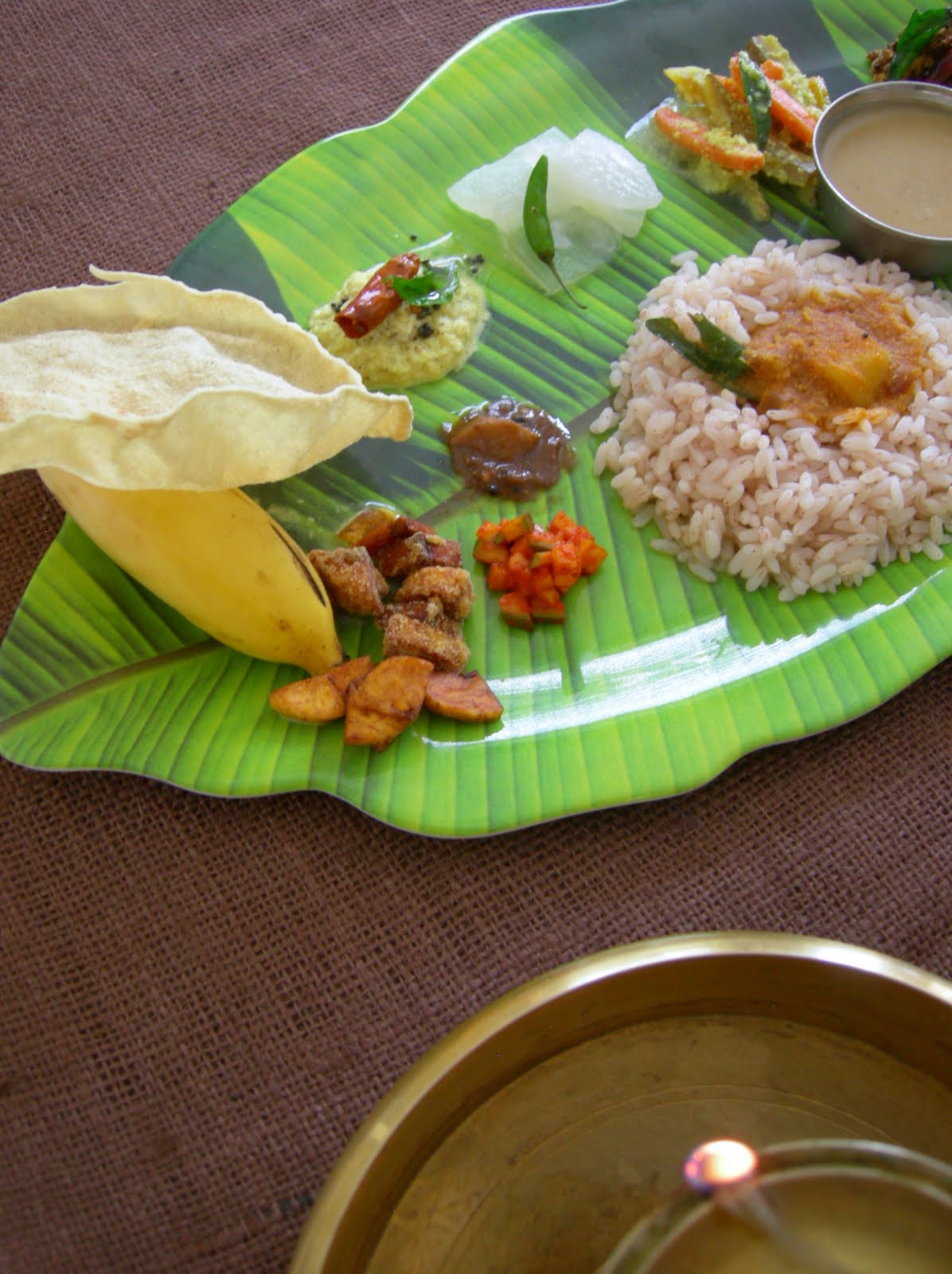
Food was served on a melamine banana leaf and the weekend allowed an Uthradom Sadya.

Ingredients
1 Cup of Palakkadan Matta Rice
3-4 Cups of water

Method
Wash and rinse the rice in 2-3 changes of water until the water runs clear
Bring water to a boil and put the washed rice in
Bring to a boil and cook for 30-40 minutes
 at this stage check a  rice grain which should give into pressure  and become soft
Switch off the stove
Drain, leaving some liquid in the pot
Cover and leave on the stovetop.

Traditional Onam Delicacies: Sadya Vibhavangal

Onam Sadya Vibhavangal


Kaalan,    Olan
Avial,       Erisseri


Parippu Prathaman, Varutha Upperi and Sharkkkara Upperi

 From Left of the leaf: Varutha Upperi/ Kaaya Upperi. Sharkkara Upperi,
Relishes: Manga Kari, Mulaga Pacchadi,
Cheru-pazham/small banana, Pappadum/fried lentil wafer,
The curries: Kaalan, Olan, Avial, Erisseri, and Varutharacha Sambhar served over Matta-Ari/ Matta Rice
Condiments: Nei/Ney, Uppu, Parippu
Sweet in bowl: Parippu Prathaman.

Traditional Onam Delicacies: Avial


Have used the traditional method  in this recipe; potatoes and tomatoes are not used in this recipe. The other traditional vegetable, Elephant Yams, is available only in frozen 'cubes', hence not used.  Did not get fresh Indian long beans, which are also traditionally used alongwith Ivy gourds/ Kovakka, a small amount of Bitter Gourds/ Kayapakka.

Ingredients
All vegetables are cut the same length
1 Cup, Carrots cut into 1 1/2 inch long sticks
1 Cup Winter Melon
1 cup Yellow Pumpkin
1 Cup Raw Plantains
1 Cup Drumsticks [frozen used here]
2 hot green chillies, slit
1 stem Curry leaves
1 Cup sour buttermilk
Coconut Oil
1 1/2 tsp Turmeric Powder
Salt
1 cube Indian Jaggery [ optional]
For the coarsely ground paste
1/2 Cup Coconut, grated


Method
Coarsely grind the coconut [ chathakyukka] and keep aside.
One can also use half of the sour buttermilk to grind the coconut paste
Cook the vegetable separately with just enough water, salt and turmeric powder: about 1/8th tsp for each vegetable
Drain and keep aside.
Heat a wide-mouthed vessel
Add the vegetables, the  ground paste and slit green chillies,
Shake the vessel to coat the pices evenly
Or turn gently with a ladle,
Add 1/2 tsp of turmeric powder and 1/2 Cup of buttermilk
Bring to a gentle simmer
Drizzle with coconut oil and fresh curry leaves.
Take off the heat and serve.

Traditional Onam Delicacies: Olan/ Winter Melon in coconut milk


Southern Malabar Olan for sadya/feast usually follows a very simple recipe of boiling the ash gourd/ winter melon with slit green chillies and the final addition of thick coconut milk. It does not add cowpeas or azuki/ adzuki beans. The traditional, home-style Olan uses only water to cook the tender winter melon.
Ingredients
2 Cups Winter Melon cut in square slices
2 thai hot green chillies
1/2 Cup thick coconut milk
Salt
Water
Method
Cook the sliced winter melon with just enough water and slit green chillies until done
Take off the heat
Add 1/2 Cup of thick coconut milk,
Add salt  and drizzle with coconut oil.

Sunday, August 22, 2010

Traditional Onam Delicacies: Pazham Puzhingiyathu Pappadum/ Stewed Plantains and Pappadams


Stewed plantians in Indian Jaggery with Pappadums/ Fried Lentil wafers is a tradional Onam breakfast among the extended clan...
Pazham =Plantains/ Bananas, Puzhingiyathu = one that is boiled.
Each family has its own favourite method. Some steam the ripe plantains, others boil them and some stew with jaggery. Some lightly pan-fry the steamed plantains in the leftover oil used to fry the pappadums. The plantains are washed, the skin is left on them and they are cut into 2 inch chunks. They are then stewed with jaggery in soapstone vessels on slow heat while hectic preparations go on for the afternoon feast.

Saturday, August 21, 2010

Traditional Onam Delicacies: Kaaya Tholu Upperi/ Green Plantain-Peel Fry

This is one of the twendyfive-different-uses/  'see-how-we-do-it-with-all-parts'/nothing-wasted recipes, that tie a Keralite inextricably to his/her benana plant and cocknut tree!

Kaaya tholu = Greeen plantian skins. Kaaya Tholu Upperi/ Kaaya Tholu Mezhukkupuratti,  is a pan-fried dish and a precursor to any festive occasion, usually made from the bounty of  peels from the plantains used to make Sharkkara Upperi and Varutha Upperi. So it also becomes a Sadya-thalaennu = the- day-preceding-the-feast-dish, served the during the previous night for dinner. It is a favourite accompaniment for Kanji = rice porridge or an accompanying side-dish for rice, in the days before the final  Onam celebrations.

Ingredients
3 Cups finely chopped plantain skins, [previously soaked in turmeric water for 30 mts and drained]
1/4 tsp turmeric powder plus
1/2 tsp for the turmeric water used to soak the plantain skins
1/2 tsp red chilli powder [optional]
Salt
1/2 tsp mustard seeds
2 dried red chillies
1 stem curry leaves
2 tbsps coconut oil
Method
Cook the finely chopped plantain, in  water, with salt and turmeric.
Once cooked, drain and keep aside
Heat coconut oil and temper the mustard seeds, red chillies, and curry leaves
Add the cooked plantain peel and saute
Add turmeric powder and red chilli powder and saute on medium high for 4-5 minutes
Serve.

Traditional Onam Delicacies: Sharkkara Upperi / Jaggery coated plantain chips

Turning out perfect Sharkkara Upperi usually takes time. Sharkkara Upperi is a jaggery coated fried plantain wedge, lightly spiced with dried ginger and cummin. It is always accompanies other fried condiments like Varutha Upperi = Salty fried plantain wedges, Chakka Chula Varuthathu = fried green jackfruits in the tradtional feast. Jackfruit and its appearence  in an Onam feast depends on the vagaries of the monsoon and the ability of a good fruit to survive until the harvest season.

However Sharkkara Upperi and Varutha Upperi are twins, traditionally home-made in the early days of Onam. Variations come both in the size and shape, the spicing mix;  some add powdered cardamom and omit one or the other spice. Others suggest soaking the raw plantain in sour buttermilk to remove the starchy serum.

Ingredients
1 1/2  medium sized green/ raw  plantain, skin removed and soaked in water for 30 minutes
3 1/2 tbsps or 1 large cube of Indian Jaggery, roughly the weight of the fried plantain chips
1/8th Cup of water
1/2 tsp powdered dried ginger/ Chukku
1/4 tsp cummin seeds, powdered
2 tsps fine powdered sugar
2 tsps of clarified butter/ ghee
1 1/2 Cups of Oil for frying [vegetable oil used here, traditionally coconut oil is used]
Method
Soak the peeled whole plantain in plain water for 30 minutes. This is to  remove the sticky residue/ serum of  raw plantain. Remove after 30 minutes and wipe dry with paper towels.

Cut the plantain into 4 long slices and slice into wedges about 3/4 cm thick
Heat the oil on medium high.
Check with a single wedge: it should not brown immediately
Adjust the heat accordingly
Put the cut wedges in the oil and cook until golden brown on an even medium heat
Stir occasionally so that the wedges do not crowd or stick to each other
It should take about 20 minutes or more
Remove with a slotted spoon and drain on paper towels completely.

Heat a heavy bottomed, wide-mouthed pan on medium high
Melt the jaggery with the water and stir well as it foams up
Skim the foam
Add the spices: dried ginger and powdered cummin
Once the jaggery is of a thread consistency: 2-3 thread consistency, add the fried plantains and mix well, making sure that the wedges are coated evenly,
Add the clarified butter
Turn the heat to low
Sprinkle the powdered sugar over the pieces
Mix well
Take off the heat and allow to cool completely
Store in an airtight container.

Friday, August 20, 2010

Traditional Onam Delicacies: Kurukku Kaalan

Have posted  about this traditional Kaalan recipe previously. This is the recipe served for feasts and special occasions; it does not use any vegetables unlike other variations and is known as Kurukku Kaalan or Katti Kaalan/ thick Kaalan.

This will keep for a few days and is a perfect Friday-Cooking dish; it is also a made-ahead dish for the Onam feasts. This sour chutney usually accompanies rice. Happy to fall back on a routine of Rice, Kaalan and Manga Kari after a week's vacation of theme park food!

This will go to Melodie's Vegetarian Foodie Fridays  and the   Friday Food event hosted at Trends and Tips.

Ingredients
1 Cup grated coconut
1 cup sour buttermilk
2 finger hot green chilli peppers
1/4 tsp Cummin seeds
1 tsp fresh powdered black pepper
1/4 tsp turmeric powder
Salt
1 pinch of roasted and lightly crushed fenugreek seeds
For tempering
1 tbsp Coconut oil
1 tsp mustard seeds
2 dried red chillies
1 stem curry leaves

Method
Grind the grated coconut, cummin seeds, green chillies into a smooth paste with little water [ 2-3 tbsps of water].
Keep aside.
Heat a heavy bottomed pan with the buttermilk on medium high
As it starts boiling, add the turmeric powder,
After 7-10 minutes keep checking the buttermilk which will start reducing to a paste,
Add 1 tsp of black pepper powder and mix well,
Stir and mix well while it reduces so that it neither burns nor sticks to the bottom of the pan.
You will get about 5 and half tablespoons of the Kaalan Kurukku/paste from 1 Cup of Buttermilk. Scoop the paste from the pan and keep aside.

At this stage you have to check for the sourness of the paste; this would depend on the sourness of the buttermilk used.
[At this point you could refrigerate this paste]
Here I have added 2 tbsps of the reduced buttermilk paste/kurukku to the ground coconut paste in the same pan.
Cook on medium low heat for 2 minutes and take off the heat.
Heat 1 tbsp of coconut oil to a smoking point,
Temper mustard seeds, then broken red chillies and curry leaves,
Add a pinch of ground fenugreek seeds and pour immediately pour over the Kaalan.

*Note: The amount of paste would depend on the sourness of the buttermilk. This paste will stay in the refrigerator; keep in a clean dry air-tight container. It could also be frozen into 1-2 tsp cubes. It will increase in sourness with time.
Am updating this post and sending it to Back to Basics event, hosted at Served with Love,   and started by Jaya, at   Desi Soccer Mom.
Had been meaning to do this but somehow, mixed it up with another event,  and thought that the deadline was over...then realized that one still had time to submit.

Traditional Onam Delicacies: Mulaga Pacchadi/ Molaga Pacchadi


Mulaga Pacchadi/ Molaga Pacchadi: Green chillies stewed in a tangy tamarind sauce. Mulaga Pacchadi is a close relative of the more famous Puli Inji, the tamarind-ginger relish served in traditional feasts.

Did a search for this and did come across a similar recipe but not much. However Puli Milaga   is quite well know in Tamil cuisine and in the other South Indian regions. The  variations in this recipe include the use of turmeric powder, pearl onions, methi/ fenugreek seeds, cummin, ginger and jaggery. Tempering spices also varied to include or omit urad dal seeds, asafoetida,  alongwith mustard, dried red chillies  and curry leaves. The way chillies are used also differ; one Tamil recipe grinds the chillies into a paste, but the most  require chopped green chillies.

Mulaga pacchadi uses whole slit green chillies which have been deep fried in gingelly oil/ sesame seed oil. The chillies are then stewed in a tamarind pulp, spicing with just a touch of crushed mustard seeds and sesame seeds.  This dish is meant to stay for a few days, without refrigeration,  in a warm huimd climate with the light monsoon rains that accompany the Onam festival.

Traditionally,  round green chillies [unda mulagu] were used, the idea was to get shorter plumper one's which can be easily portioned  and served. Since this was not feasible for big feasts,  it was left to the server to decide which person's leaf got the chilli or just the sauce! Either way, the result was a delicious combination of flavours on the green leaf.
Ingredients
6 long green cayenne chillies/ green chillies
[ have used 4 Thai hot chillies and 2 green cayenne ]
Gingelly Oil/ Sesame Oil for frying
A lemon sized ball of dark tamarind/ 4 tbsps of dark tamarind paste
2-3 broken red chillies
1 stem curry leaves
1/4 tsp sesame seeds, crushed
1/4 tsp mustard seeds, crushed
3/4 tbsp jaggery
Salt

Method
Soak the tamarind in 1 1/2 cups of water in small batches/ quantities, sqeezing out all the pulp.
Keep aside,
Heat 1/4 cup of gingelly oil and deep the slit green chillies until glossy
Drain and keep aside
Heat 2 tbsp of oil and temper the mustard seeds, broken red chillies and the curry leaves
Add the green chillies and the sqeezed out pulp
Add salt  and cook on medium high heat for at least 10 mintues
Add the crushed jaggery and simmer for 5 more minutes.
Add the crushed sesame seeds and mustard seeds powder
Add more water if needed.
Check for seasoning and salt
The final dish should have thick, clinging, sauce; it  should be  reduced to half of the original amount.
Note: more amount of crushed mustard seeds will reduce the shelf-life of the Pacchadi; it will ferment soon.

Tuesday, August 17, 2010

Bookmarked Recipes: Idichakka Upperi-Tender Jackfruit Stir Fry

Idichakka, the term for tender jackfruits. Idichakka Upperi [ as we call it in our nook] or Thoran is a very traditional and simple method of cooking tender jackfruits; variations abound with the addition of cummin, coriander powder, crushed/sliced garlic, ginger in some, ground paste of coconut, cummin, curry leaves, a variety of lentils in the tempering stage.

Tender young jackfruits in the Indian Grocery store prompted this  early summer favourite. This recipe Idichakka Podithooval is taken from Rojas Recipes .

Ingredients 
Half of a small tender jack fruit/ 3 cups of cleaned, green spiky rind removed, chopped jackfruit
1/4 Cup grated coconut
1/4 tsp turmeric powder
1/4 tsp red chilli powder [ optional]
Salt
For Tempering
2-3 tbps of coconut oil
2 red chillies for tempering
1 stem of curry leaves
1/4 tsp of mustard seeds
1/4 tsp urad dal seeds
4 small red onions/ shallots, sliced 
Method
The original uses  a ground paste; I have used grated coconut  in the 'garnish' method.
Cook the jackfruit pieces with salt and turmeric until tender
Shred the jackfruit into a coarse mix [ one can also use a food processor- just pulse for a couple of seconds, no more]
Heat  coconut oil,
Temper mustard seeds, urad dal seeds, red chillies, curry leaves and add the sliced shallots
Add red chilli powder at this stage
Add the shredded jackfurit and mix well
Cook  in the stir fry method for 4 minutes
Check for seasoning
Add the grated coconut and cook for a few more minutes, serve.

This recipe goes to Priya's Bookmarked Recipes: Every Tuesday event.

Tuesday, August 10, 2010

Butterbeer...

After thumbing our noses at this type of 'entertainment' for all our lives, we finally packed our bags...
and arrived into the gathering storm...

...to sample some butterbeer...
Then stepped into a dining space, bringing waves of nostalgia for the smoke-washed kitchen's of a place very different from this!

We bypassed the luscious looking beef-vegetable filled Cornish Pasties and Shepards Pie but did have some fish and chips and potato leek soup.
........
then zimbly gawked at  the overcrowded candy shoppe...


Thursday, August 5, 2010

Kadala Kari: Kerala Black Chickpeas Curry

Puttu

Kadala Curry/ Black Chickpeas Curry
This favourite accompaniment to Puttu has variations from home to home in Kerala. The most basic combination [suggested from the Thiruvananthapuram region]  was to boil the chickpeas with salt and turmeric, season with a tempering of mustard seeds, red chillies, curry leaves, perhaps a heap of sliced shallots,  and generous drizzles of coconut oil. The addition of coconut and roasted coriander seeds paste was another traditional combination.

Varutha Aracha Kari = Roasted and Ground Kari, would lightly roast all the spices and coconut, then grind it to a paste. Garlic, ginger, tomatoes and sauted onions in the gravy were variations alongwith a couple of  basic Kari-masala spices. It also extended to the whole gamut of kari masala spices in some recipes: Cinnamon, cardamom, cloves, aniseeds, cummin and black pepper.  Another version uses coconut milk, instead of the ground coconut-spice paste. An unfortunate  version exists as  a staple hostel food in Kerala. This would be a plain boiled chickpeas in brown water, hopefully salted, served with slices of store-bought bread!

The following recipe  is the version made in my maternal grandparents home and extended clan. The rich red colour of the gravy and the proper, soft texture of the chickpeas came from slow cooking in Kalchatti's [soapstone cooking vessels]  on wood burning stoves.
Ingredients
1 Cup black chickpeas, soaked in water overnight
1 Cup of grated coconut
2 shallots/ small red onions/ sambhar onions
1/2 tsp coriander seeds
2 dried red chillies [or more according to taste]
3 cloves of garlic
1 tbsp of chopped ginger
[Optional: Kari masala= usually one cardamom and a small piece of Indian cinnamon]

For tempering
1/2 tsp mustard seeds
2 dried red chillies, broken
2-3 shallots, finely sliced
1 stem curry leaves
1 1/2 tbsp coconut oil

Method
Boil/ Pressure cook the chickpeas with salt and turmeric powder.
Heat  1 tbsp of coconut oil,
Roast the shallots, dried red chillies until glossy, about 3-4 minutes
Add the grated coconut at the last minute.
Saute for a minute.
Grind to a smooth paste adding water as required.
Add this paste to the chickpeas and  let it come upto a gentle simmer
Cook for 5-7 minutes
Heat the coconut oil to smoking hot,
Temper the mustard, red chillies, curry leaves and finely sliced shallots
Pour the tempering over the curry.
Drizzle with coconut oil, if needed
Serve.

Monday, August 2, 2010

Nool Puttu: Steamed Rice Noodles/ Traditional Kerala String Hoppers

Puttu/ Pittu recipes  evoke   a tradition of homely breakfast and a tea-shop favourite for many Keralites. Similar dishes abound in the geographical trail of colonization, commerce, conquests, migrations,  and trade.

In our nook we call these Nool Puttu  = String puttu; Idiyappam is a common  name, Sevai  the most popular Tamil  version; Shevayi  in the Karnataka region. Srilankan's call it Indi Appa. The basic ingredient is rice flour, salt and water; the differences  come in the variety of rice, the way dough is made, extruded and its consistency.

Traditionally rice [usually parboiled] is soaked for a few hours, drained on cotton towels, dried in the shade and pounded. It is seived, the finer powder is taken for the nool puttu, while the grainier powder works for the Uthir Puttu/ Kuzhal Puttu/Kutti Puttu= moistened rice flour mixed with coconut and  steamed in bamboo stems. Named for the cyclindrical, tube like shape.

Instant Versions: There are several 'instant' versions: dried string hopper parcels, which need the minimal effort: soak in hot boiling water, drain, season/temper and serve. Searching for  different variations brought about this jaw dropping innovation, the SevaiMagik.  How did I miss this one? It seems to be in the market since 2007; am really curious to know how well it works!

Was quite tickled by the original tamil advertisement; the flawless-tv-mom's demeanour cracks a bit, just like the carefully messed-up tendrils on a sweatless, made-up brow. The perfect housewife who no longer sits at home but works full time still get up 5 am, has to reach the office at 9 am. Before that she has to cook breakfast and lunch, wash the clothes and take care of  her kid and who has time to cook the variations for the kid and MIL??!!

Accompaniments
Nool Puttu is served with fresh grated coconut,  tiny honey-sweet bananas and pappadums.
Milk and sugar combinations are a childhood staple.
Ishtu/stew or Kadala Kari- Black Chickpeas Curry, Cherupayar Curry/ Mung beans curry, Vegetable Kurma are other vegetarian accompaniments.
Our favourite combination for Puttu is pappadums and more grated coconut!
[These could be shamelessly indulged in only at our grandparents home with a bounty of fresh coconuts].
Roasted rice nool puttu 
Ingredients
2 Cups of raw long grain  rice powder [paccha-ari]
One can also use parboiled, red rice powder which can also be lightly roasted.
2 Cups of boiling water or less
[ the amount would depend on the quality of the rice powder]
1 tsp of ghee/ coconut oil
Salt
Equipment
Sevanazhi or a Press, using the tiny mutli-holed disc.
Steaming plates or Idli moulds.

Method
Grease the Idli moulds or the Idiyappam moulds.
Spread 1/4 tsp or more of fresh grated coconut on the mould.
Bring the water to a boil, season with salt and ghee-clarified butter.
Add water to the rice flour and mix well with a firm ladle.
The dough should have a soft consistency.
Once the dough is slightly cool, enough to handle , knead the dough and press it through the sevanazhi onto the greased idli moulds.
Steam for about 10 minutes.
Let cool for a few minutes, take off the moulds and serve.

This recipe goes to the Steamy Kitchen Event!